Civic Prosperity at 250: From Sacred Honor to Shared Flourishing
As the United States marks its 250th anniversary, this Braver Angels Civic Scholars Council series examines the concept of courageous citizenship and the conditions needed to strengthen civic engagement and democratic institutions, arguing that active citizenship beyond merely voting is critical to preserving American Democracy.

Most of us are in at least one relationship that politics has eroded: a family member we’ve stopped calling, a friend we’ve muted, a colleague we steer clear of at office gatherings. Staying in such relationships, and repairing them when needed, is one of the everyday costs of courageous citizenship. So is speaking your mind with people who might judge you for it, defending an equity-minded process when there is opposition to it, and staying in conversation when changing the subject would be easier. Citizenship has never been easy, and democracy has always depended on people willing to bear such costs for shared purposes. Two hundred and fifty years into the democratic experiment, the costs are more relational and reputational than mortal, but the demands echo the ones our founders accepted.
Today, many Americans feel underequipped to meet the demands of the day. The share of Americans who say “most people can be trusted” has fallen from 46% in 1972 to 34% in recent years. The 51st Harvard Youth Poll last fall found that only 13% of young Americans believe the country is headed in the right direction. The Kettering Foundation’s Democracy for All Project finds that Americans across political lines want to work on shared problems but face barriers to doing so in their communities. Ours is a civic ecology under strain.
Meeting this moment takes more than rhetoric about civic duty or better-designed deliberations. It takes attention to what Project Pericles calls civic prosperity: the conditions through which people develop the identity, trust, and capacity to shape democratic futures together. Organizations from Campus Compact to Citizen University to Braver Angels and many more are strengthening these conditions through education. Civic prosperity is a systemic condition built or degraded through societal and institutional choices, which in turn influence whether courageous citizenship becomes widespread and sustained. We cannot expect the preponderance of people to be active and brave in civic life if we do not cultivate conditions for bravery, and few would argue such conditions are being sown today.
The Semiquincentennial of the United States Declaration of Independence is the moment to recommit to the founding principles and promises the country has never fully realized, and to shift from sacred honor borne by a heroic few to shared flourishing made possible by and for the many. Building civic prosperity is shared work: families, community organizations, employers, congregations, and local governments all help shape whether and how people can participate fully in civic life. Colleges and universities have the potential to play a meaningful role in this work. They are a training ground and a bridge between private identity and public life, and should serve as both anchors of and engines for civic prosperity. Because most citizens pass through them on the way into public life, colleges help determine whether our civic ecology grows healthier or more strained. Whether that influence builds civic prosperity comes down to design or default.
Civic prosperity is an old idea. Pericles, the namesake of Project Pericles and the figure Thucydides called the first citizen of Athens, championed its principles long before anyone named them. In the Funeral Oration Pericles argued Athenians shaped their democracy as active participants and understood that living well in private depended on the health of the public sphere they shared. “We alone,” Pericles said, “regard a man who takes no interest in public affairs not as a harmless, but as a useless character.”
Civic prosperity exists when enough people, across enough of the social fabric, develop the identity, trust, and capacity for courageous citizenship to be a widespread, realistic expectation rather than an exceptional achievement. The conditions that make these elements possible, and the outcomes that can follow, extend well beyond any single sector, as the framework below shows.
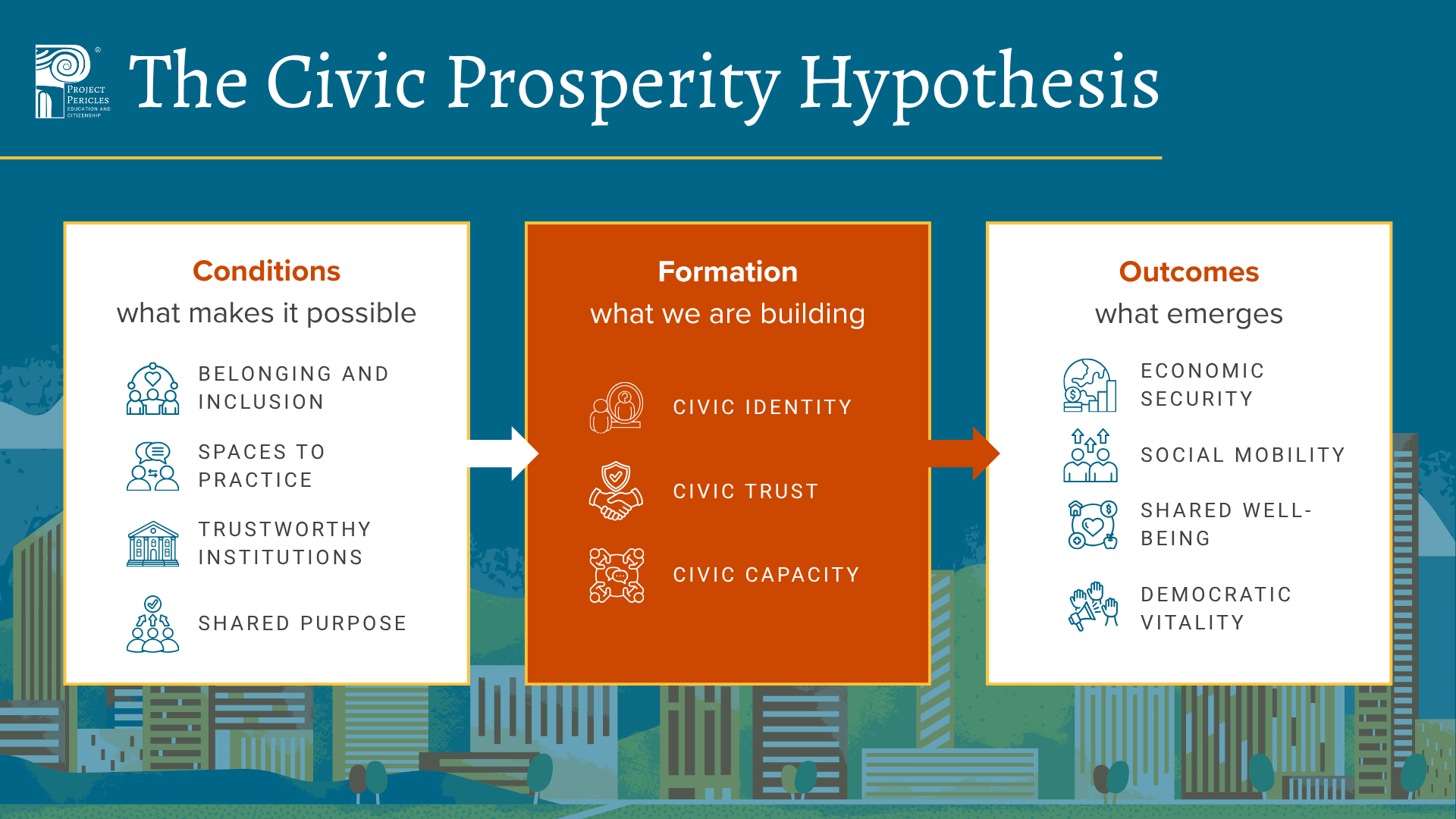
Three elements compose it.
Civic identity. People must see themselves as agents with a stake in democracy rather than simply consumers of public services or partisans in zero-sum competitions. The replacement of citizens with bystanders contributes to declining engagement and rising susceptibility to authoritarian appeal. Identity precedes action: one is unlikely to sustain the considerable costs of participation without believing they are someone who can and should participate.
Civic trust. Democracy depends on a particular kind of relational trust: the capacity to take seriously the good faith of people on the other side of a disagreement and to believe productive disagreement is possible across deep differences. Without it, there is no foundation for constructive deliberation and public life turns adversarial. When people stop believing shared reasoning is possible, participation isn’t worth its cost.
Civic capacity. Identity makes engagement appealing, trust makes it possible, and capacity makes it effective. People need practical skills – to engage with others across differences, to turn disagreement into collective problem-solving, to navigate civic institutions – that are learned through practice inside and outside the classroom.
Higher education has long invested in capacity, through service-learning, community engagement, and voter registration, and more recently in fostering trust through dialogue and civil discourse programs. Civic identity, the foundational question of whether and how students understand themselves as citizens with a stake in democratic life, has drawn less systematic attention and investment. For civic prosperity to prevail, all three elements must be cultivated together, by design, as interdependent.
When we think of courageous citizenship, we tend to think about exceptional individuals like Rosa Parks, John Lewis, and Malala Yousafzai. While inspirational, this is an insufficient basis for democratic renewal. What democracies need is a broad distribution of the willingness to bear the ordinary costs of participation: showing up to a contentious town meeting, challenging a colleague’s political assumptions, staying in relationship with a family member whose views you find objectionable, writing to a local official, voting in a midterm. Each of these carries risk – of conflict, of discomfort, of wasted effort – yet together they sustain democratic life.
Harry Boyte’s conception of public work clarifies what this requires. Democratic citizenship, in his schema, is a self-organized, collaborative effort to create things of lasting civic value. It is productive rather than merely expressive. It depends on conditions that make sustained effort possible, which includes tools, relationships, institutional support, and a sense that one’s work matters. This framing shifts the question from how to inspire more engagement (exhortation) to what makes engagement sustainable (institutional redesign), which is what civic prosperity requires. Peter Levine makes a parallel case for deliberation, underscoring that success depends on equitable, uncoerced, open-minded participation that institutions are best positioned to cultivate.
One need only look around – or watch television, listen to the radio, read the newspaper – to discern that one of the hardest civic acts in a polarized society is sustained engagement with people whose views one finds deeply wrong-headed. Staying in relationships, taking such perspectives seriously, and remaining open to persuasion draws on all three elements at once: the identity to believe the relationship is worth the effort, the trust to stay in conversation, and the capacity to navigate it without capitulating or breaking off. Building these capacities is the work of institutions that take civic development seriously and cultivate it over time.
Public work and deliberation in education are practices through which civic prosperity gets built. When students in a vocational program deliberate about immigration policy, they develop the identity and trust that turn skills into habits of heart and mind. When students co-produce knowledge with community partners, they build the capacity and commitment for grounded partnership. Courageous citizenship is formed through this work.
Conditions for civic prosperity are achievable, and they produce recognizable and rewarding effects. The programs that follow, drawn from different institutions, demonstrate what deliberate cultivation of civic prosperity looks like on the ground and provide tangible evidence that these design conditions are within reach across varied settings.
Civic learning in the trades. Angela Graves teaches at Alfred State College, a New York polytechnic where most students train for careers in fields like HVAC, welding, and plumbing. With a Project Pericles mini-grant, she used deliberative dialogue modules to help students define twenty-first-century citizenship in terms tied to their careers and communities. Trades students are rarely targeted by civic engagement work. Graves’ students and colleagues came to see civic learning as integral to technical education, and the curriculum ran without displacing vocational goals. Alfred State has seen steady increases in voter registration since. Graves’ work shows what changes when colleges invest in treating students pursuing trades as capable of civic development.
The op-ed as civic act. Megan Thiele Strong, a sociologist at San José State University, a Hispanic Serving Institution which enrolls many first-generation and working-class students, used a Project Pericles mini-grant to help students in a Poverty, Wealth, and Privilege course write and publish op-eds. Strong provided stipends to offset the added time and public exposure of writing for an audience – a meaningful cost for students juggling multiple jobs. One student published a piece on how public transit infrastructure shapes social stratification, translating classroom concepts into civic arguments. This is civic identity in formation: students who publish about public challenges come to understand themselves as people whose perspectives belong in public debate.
The same conditions take other forms across the consortium. At Waubonsee Community College, Aaron Lawler’s students have moved “from passive observers to active participants” over several years, registering to vote and speaking at school board hearings. Through the Periclean Faculty Leadership program, Goucher College data science students analyze public health data to help a local organization target its opioid response, one of dozens of reciprocal partnerships in which students and communities do work neither could accomplish alone. And through Project Pericles’ Civic Story Lab, Allegheny College students document housing affordability alongside residents, taking on the reputational risk that public work requires.
Each of these cases is impacted by institutional as well as individual choices: a faculty member deciding her vocational students deserve civic development; a university building the conditions for first-generation students to enter public debate; a community college sustaining a program beyond grant cycles; a consortium building faculty infrastructure for community-engaged courses and civic storytelling. Each requires prioritizing civic development alongside research productivity, enrollment pressure, and many competing pulls on time and energy. Each requires stakeholders to advocate that civic learning belongs in HVAC programs, that stipends for student op-eds are a legitimate use of funds, that complex community partnerships are worthwhile.
This exemplifies institutional courage in higher education. It gets less attention than high-profile defenses of academic freedom, vital as those are, and is more sustained, through the ongoing work of building identity, trust, and capacity into curriculum, faculty development, resource allocation, and the definition of student success.
American Association of Colleges and Universities’ (AAC&U) The Trust Agenda, a recent framework for rebuilding public confidence in higher education, tackles this challenge head on, emphasizing that colleges earn trust by becoming community assets, deepening the reciprocal partnerships civic prosperity requires. Partnerships like these build civic prosperity only when colleges can tell they are working and can commit to sustaining them past single grant cycles.
Civic prosperity asks for more than the usual metrics of voter registration, service hours, and civics test scores. These capture (valuable) outputs rather than formative conditions. Assessment should track three elements directly.
Identity: whether students come to see themselves as citizens with a stake in public outcomes, whether that view shifts over their education, and whether it lasts beyond graduation.
Trust: whether students develop the intellectual humility to take seriously perspectives they reject and to distinguish disagreement from bad faith.
Capacity: whether students gain practical skills, practice them in civic settings, and do so where the stakes carry consequences.
Few institutions, if any, currently assess all three systematically. Institutions assess what they value. The absence of civic prosperity measures signals that the work is treated as optional, at a cost to the sector and to civil society. Changing this is slow, unglamorous, institutional work – with less public drama than the signing of a declaration in 1776 – yet it is the work democratic renewal requires.
In the final line of the Declaration of Independence, the signers commit to bear the costs of democratic risk together by stating we “…mutually pledge to each other our Lives, our Fortunes and our sacred Honor.” Two hundred and fifty years later the risks and the scale of pluralism have changed but the underlying demand has not. Democracy still needs people willing to bear costs for shared purposes, and conditions that make that willingness possible.
These conditions – civic identity, trust, and capacity – are cultivated in families, communities, civic organizations, and importantly in the colleges and universities that shape how young people understand themselves in relation to the world they share. Higher education now faces a choice: treat civic development as central to its mission or treat it as peripheral and imperil the democratic experiment that has held strong for two and a half centuries.
Building civic prosperity is a decision and a commitment, and, within institutions, it falls to those with the standing to fund and protect it. Trustees and presidents must make civic development a measured priority, not merely a line in a mission statement. Funders must underwrite the slow institutional building that is rarely supported. Faculty must treat the formation of citizens as core to their work across disciplines. And it falls to all of us to stay in a frayed relationship, speak up among people who might judge us, show up where local decisions get made, and press the institutions we touch to take this work seriously. None of us should be a bystander to the civic life we share. Each choice influences whether courageous citizenship remains the work of a heroic few or the everyday practice of We the People.
Investing in civic prosperity, and bearing the cost of the investment in the current political climate, renews our country’s historic pledge in a new currency: a modern form of sacred honor. The signers treated citizenship as both a demand and a practice. At 250 years, so must we.
About the Author:

Sanda Balaban is Executive Director of Project Pericles, a national consortium of colleges and universities advancing civic learning and democracy by embedding community engagement across the curriculum and campus. She previously co-founded and led YVote/Next Generation Politics, a cross-partisan initiative equipping Gen Z changemakers for their roles as citizens. Her career spans decades of leadership in education, philanthropy, and youth development, including at the New York City Department of Education, the Ford Foundation, the Goldman Sachs Foundation, and Facing History and Ourselves. An alumna of Swarthmore College and the Harvard Graduate School of Education, she brings a systems lens, cross-sector fluency, and steadfast belief in higher education’s capacity to strengthen civic life.