Aging is Living: Redefining Longevity, Equity, and Purpose
Q&A with Myechia Minter-Jordan, MD
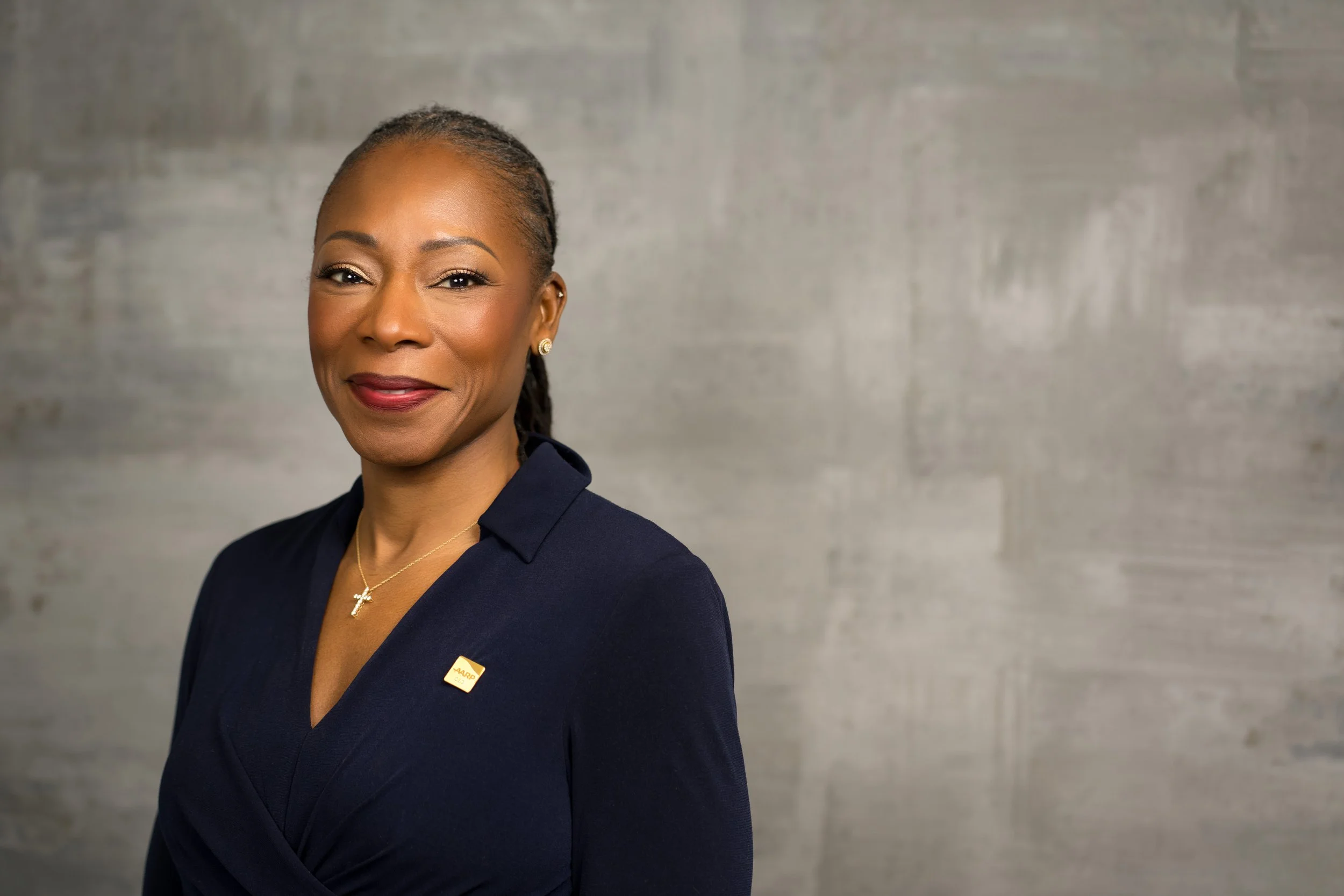
Dr. Myechia Minter-Jordan is the Chief Executive Officer of AARP, the world’s largest nonprofit, nonpartisan membership organization. Appointed CEO in November 2024, she leads nearly 2,300 staff members, 60,000 volunteers, and a broad network of strategic partners committed to empowering people to choose how they live as they age.
An accomplished physician and nationally recognized leader, Dr. Minter-Jordan brings deep expertise in healthcare delivery, social equity, and organizational transformation. She began her career in academic medicine at Johns Hopkins University before serving as President and CEO of the Dimock Center (2007–2019), where she helped establish the organization as a national model for integrated, community-based health services. She later led the CareQuest Institute for Oral Health (2020–2024), advancing innovative, philanthropic strategies to build a more equitable and accessible health system.
Dr. Minter-Jordan serves on several boards, including BlueShield of California and The Boston Foundation, and is a dedicated mentor to emerging leaders. Her honors include Harvard Medical School’s Reede Scholar Vision Award. She holds degrees from Brown University, Johns Hopkins University, and multiple honorary doctorates.
Terry Edmonds: Dr. Minter-Jordan, on behalf of the Harvard ALI Social Impact Review and the entire, Harvard ALI community, we want to thank you for sharing your thoughts about your new role as the head of AARP, especially in light of all the disruptions that are occurring right now regarding Social Security, Medicare, and Medicaid. So, the first question we want to ask is simply what AARP is. While for most of us, AARP is a household word, there may be some of our readers who are not as familiar with the organization and its purpose. Can you give us a brief overview of your vision for AARP, and why you chose to come to the organization at this time?
Dr. Myechia Minter-Jordan: First, let me just say thank you for the opportunity. It's wonderful to engage with both of you. I'm excited to be able to represent AARP. And the way that I would want your readers to understand AARP is to know that we have worked since 1958 to empower all people to choose how they live as they age. What that means is the ability to have access to good healthcare, the ability to have access to the Social Security benefits you've earned, the ability to be able to have an affordable lifestyle and have choices, whether or not that's through technology, including the technology that AARP supports as we advocate for older individuals over the age of 50, or whether or that's through just simply having the resources in your community to be able to live well and to live safely. Those are all things that are part of the mission of AARP as we talk about empowering people to choose how they live as they age.
Right now, we believe that aging is living, and we're here to ensure that the 125 million-plus individuals and Americans over the age of 50 can live with dignity, purpose and security. Our mission is to transform aging, to throw out the sort of old playbook about how we envision age, but also to broaden the way that we think about that, to make sure that we're emphasizing the understanding that people are living longer than ever.
Many of us will live to the age of 100. And we want it to be the norm for upcoming generations. We also want to make sure that those years are filled with good health. It's important for AARP to be in partnership with this community of about 125 million 50-plus Americans.
The reason that I came to AARP to answer the latter part of your question is the mission. It's because of that mission of empowering people to choose how they live as they age. I am now in the 50-plus community, and as I think about what I want for my own self, for my parents, for my loved ones, it's to have this ability to be able to be empowered, to have the information that I need to make the choices I need to make for myself and my family. And AARP has been a tremendous resource, so I feel like everything that I've done in my career, beginning with serving as a practicing physician, has prepared me for this role. The work that I've done in advocating for better rights for underserved and under-resourced communities, in providing direct care, and in being part of policy innovation and research at the local, state and national levels – all that work has prepared me for this role, and I am super excited to be in it. I feel honored and blessed to know that I am leading an organization that has such an incredible history. And with a presence in every state and territory in the country, I am very proud of how we show up in communities. As a former community health leader, these are the things that matter and reflect my own personal values. I'm really thrilled to be able to bring all my expertise and experience to AARP.
Mary Jo Meisner: Dr. Minter-Jordan, I’d love to continue along the lines of what you were just talking about and talk about the issue of social impact. I was intrigued with the interview you did with Fast Company, where you were talking about AARP in the context of economics. Is AARP embarking on Social Impact 2.0? Is this an extension, or rethinking, or evolution of the brand from a social impact perspective?
Minter-Jordan: Thank you for the question. I would start with the fact that AARP continues to lead the fight on all issues that matter most to the 50-plus population. That includes Social Security, Medicare, and family caregiving. We want to make sure that we are continuing to push for the solvency for Social Security and that we continue to lift that up as the backbone of retirement in our country.
We are also fighting for Medicare, which is the healthcare foundation for over 69 million Americans. That's incredibly important. Prescription drug costs are a big part of that. We must make sure that those medications are affordable to those who need them. We also do a lot of work in the space of fraud prevention and scams. We want to help our members and non-members protect themselves. Additionally, we're lifting this area of the longevity economy.
We know that now is the time for us to recognize the economic and cultural power of the 50-plus demographic. We have over 125 million individuals that are over the age of 50. They contribute over $8.5 trillion to the economy, and this is what we call the longevity economy. For context, almost 56 cents of every dollar spent in the U.S. comes from someone who's in the 50-plus demographic. And by 2050, the 50-plus are projected to spend almost $25.5 trillion. That is 61% of our total spending. We have an opportunity to understand that from a business standpoint, but we also work with investors and entrepreneurs who understand that this is an opportunity to be able to do good. Many entrepreneurs have a personal story and passion for the work that they engage in – whether it’s for themselves or for their loved ones. As many of them are family caregivers, or will be family caregivers, or will need family caregiving, there's this opportunity to tap into that passion and that drive and apply it to this longevity economy.
That means readying the workforce for the fact that employees will be aging. The oldest Millennials will enter their 50s in the next 5 years. Many businesses and entrepreneurs are making sure now that they have the right policies in place to ensure that their work for their environments is conducive to bringing out the best in all their employees, including those over 50. Our goal is to be that partner, that catalyst, quite frankly, working with businesses to help them understand how best to leverage the longevity economy.
We are a great partner to all sectors in that regard. And the fact that we are in community with 125 million individuals in this country, that we have a built-in network of research and development and a way to scale to reach this market, positions us as a leader in this space. We’re very excited to be able to serve as a catalyst to others as they think about how to best leverage this growing economy.
Meisner: The idea behind ALI, the Advanced Leadership Initiative, is this whole notion of a third chapter, and continuing to engage and contribute beyond your classic professional career. At the same time, we're confronting issues of ageism, which intersects with this idea of people living healthier and wanting to continue to work beyond retirement age. Can you speak about the issue of agism in this new era of healthy longevity?
Minter-Jordan: You’re hitting on an important topic that is only going to continue to grow in its importance. Age discrimination is real. It is real in the workplace. It is real in how we think about our communities. So, we work with companies and businesses to help them understand how ageism can show up. We've established something called livable communities. These are communities that are focused on being age friendly. We've established over 1,000 across the United States – from Pennsylvania and New York to California and the State of Washington.
We know that the scale of change is great – 60 million Americans over the age of 65. By 2040, that number increases to 80 million. And by 2030, for the first time in history, we'll have more Americans over the age of 65 than under 18. This is the time for there to be radical change. Part of what we promote is that aging is living, and there's a full spectrum of what aging looks like. There can be someone who is in need of additional support in order to walk, in order to hear. There could be someone who is incredibly active and doesn't have the same needs. I believe we need to expand our minds to be able to say that aging consists of all those things. If we're not aging, what is the alternative? We believe that when it comes to aging, there's a full spectrum of what that can mean for individuals and their families. Our goal is to support people along the way.
We want to make sure that we are lifting up the opportunities for those who are aging, as well as some of the challenges. And again, working with the business sector and communities to ensure that we understand what the barriers are to having that full, wholesome life that we all want.
We all want our aging to be graceful, to be safe, to be full of dignity, and full of respect. so, how do we ensure that we're bringing the voice of the American people to all these different sectors to be able to account for that, and thus to be able to combat age discrimination.
One of the areas where we’ve shown up to change some of the perceptions of aging is the film and movie industry, lifting up older actors and highlighting their amazing careers. We do that through Movies for Grownups, which is an annual awards ceremony honoring movies and films featuring actors over the age of 50. During the lead-up to that event we focus on telling the stories of writers, directors, actors, and their contributions to the industry. We have also worked with Getty Images to change some of the imagery associated with aging.
Edmonds: Can you talk a little bit about the particular challenges that older people in marginalized communities face? That includes women, people of color, people with disabilities.
Minter-Jordan: As an African American woman who is in my 50s, I am aware there is discrimination and inequity in communities of color and under-resourced communities. As we focus on the entire aging population, we understand that there needs to be a focus on inequities as well. We want everyone to have an equal and equitable opportunity to be able to choose how they live as they age. That’s why we have to be much more diligent in understanding where those inequities lie, so we can better craft our programs and services to address those specific inequities and how they show up in under-resourced communities. Everything we’ve talked about today impacts under-resourced communities. It's critical for us to have a lens on that as well.
Edmonds: Social Security is a foundational piece for so many people, and probably more so for people in marginalized communities. AARP just did a new survey on Social Security. What did you find in that report, and do you have ideas for next steps?
Minter-Jordan: First of all, we found that more than 70% of Americans value Social Security and see it as a critical program. We know that it is the primary source of income for half of the 68 million Americans who receive it. Every year, it lifts more than 16 million seniors out of poverty, and without that, the senior poverty rate would more than triple.
We also know that the program is projected to have a shortfall within a decade. That doesn't mean bankruptcy, but it means there’s an issue with solvency, where the benefits could be reduced by about 20%. We're lifting up the need for continued attention to Social Security, understanding that it is critical to our country.
We also know through that survey that younger adults are worried about whether or not Social Security will be there for them as they age. We want to reassure younger adults, but at the same time, activate them to be focused on Social Security at an earlier age. I was asked this question at a recent discussion about how young people should think about this. We say if you are waiting until you're 50 or 65 to think about retirement, you're too late. It’s important when you get that first job and start to see your contributions to Social Security to understand that it is an earned benefit. To ensure that we have access to it, we must be prepared and empowered to fight. For example, when the Social Security Administration proposed cutting phone access to key services, AARP mobilized immediately through formal comments and organizing over 2 million activists around the country to send messages to lawmakers. AARP members helped to reverse those decisions, which protected access for millions of older adults, especially those in rural communities who depend on phone services. The power of AARP rests in the Americans who are our members and our non-members, those activists who understand these issues.
We continue to ensure that we’re shining the light around Social Security. We did that through this year’s 90th celebration of Social Security, and we continue the active drumbeat to ensure that this congressionally approved and appointed program is there for us. We have to change the narrative around what it is. It is an earned benefit – something that we contribute to when we work in this country. It’s the promise that America made to its citizens. We are holding America and all of our congressional representatives to that promise.
Edmonds: The ALI program is an international program. Some of our fellows come from all corners of the globe. Many of our readers may not know that AARP has an international footprint. You were recently at the Vatican, and you've spoken at the UN. Can you tell us a little bit about the international footprint of AARP?
Minter-Jordan: It was surprising to me to learn that AARP has such a robust international presence, and I am thrilled to be able to participate in important discussions and actions being taken around the world. The recent symposium that we had in Italy at the Vatican addressed that fact that we are in a major global challenge of our time. By 2050, there will be 2.1 billion people age 60 or older, with 80% in low-to-middle-income countries. So, we have had a commitment to being a leader in addressing global aging issues since our founding. The Vatican meeting was an important opportunity for us to take a serious and holistic approach to this monumental change.
Part of the work that we do on an international level is spearheading these conversations in partnership with other organizations. AARP is helping to highlight the implications that this global aging population has on topics like health management, caregiving, finances, community development, housing, social connections, and more. We work with leaders around the world to be able to share our learnings and to learn from them. We are bringing those teachings back to the United States as we think about influencing domestic policy, as well as our own programs and services. It's an important aspect of the work that has been done since our inception and that we will continue to do in the future.
Edmonds: Do you have any advice on how the social impact community can collaborate with AARP on these issues?
Minter-Jordan: I think the most important thing is awareness. Once you understand the changing demographics of our country and of the world, and once you recognize the spending power of the 50-plus, there's opportunity, in all our social work, to leverage a lens of aging.
As social impact leaders seek to deliver their objectives and goals, it is critical that they view their work through the lens of aging. Because we’re all focused on improving the lives and outcomes of those who are underserved or under-resourced, that means understanding that there should be different considerations for the 50-plus in that work. And so, we would be pleased to partner with leaders as they are thinking that through. We are a credible resource. We do an immense amount of research, highlighting the needs and the stories that inform our work. We want to partner with organizations and individuals who are looking to make social change and to bring that lens of aging to their work in a way that will only help to improve outcomes in the long term.
Edmonds: Is there's anything that we haven't covered that you'd like to add?
Minter-Jordan: The last thing I'd say is that we know that longer lives can be lives of greater purpose, deeper relationships and continued contribution. But we have to build the support systems that people need in order to be able to do that. How can we ensure that everyone has the opportunity to age with dignity, security, and purpose? And what do we want that to look like for ourselves? So, whether or not you are 50-plus, 20-plus, or 30-plus, now is the time to envision what you want the rest of your life to look like. Now is the time to think about how we can take charge and lead with purpose. AARP is here to be a partner. Thank you.
About the Authors:

Terry Edmonds is a 2021 ALI Fellow with deep expertise in communications and public affairs. He served as chief speechwriter for President Bill Clinton, the first African American in the role, and has written for senior leaders across government, nonprofits, and major institutions.

Mary Jo Meisner is a 2017 ALI Fellow and former Vice President of Communications, Community Relations and Public Affairs at The Boston Foundation. A veteran journalist, she held executive roles at major U.S. newspapers, including The Washington Post, and has served three times as a Pulitzer Prize juror.
This Q&A has been edited for length and clarity.