
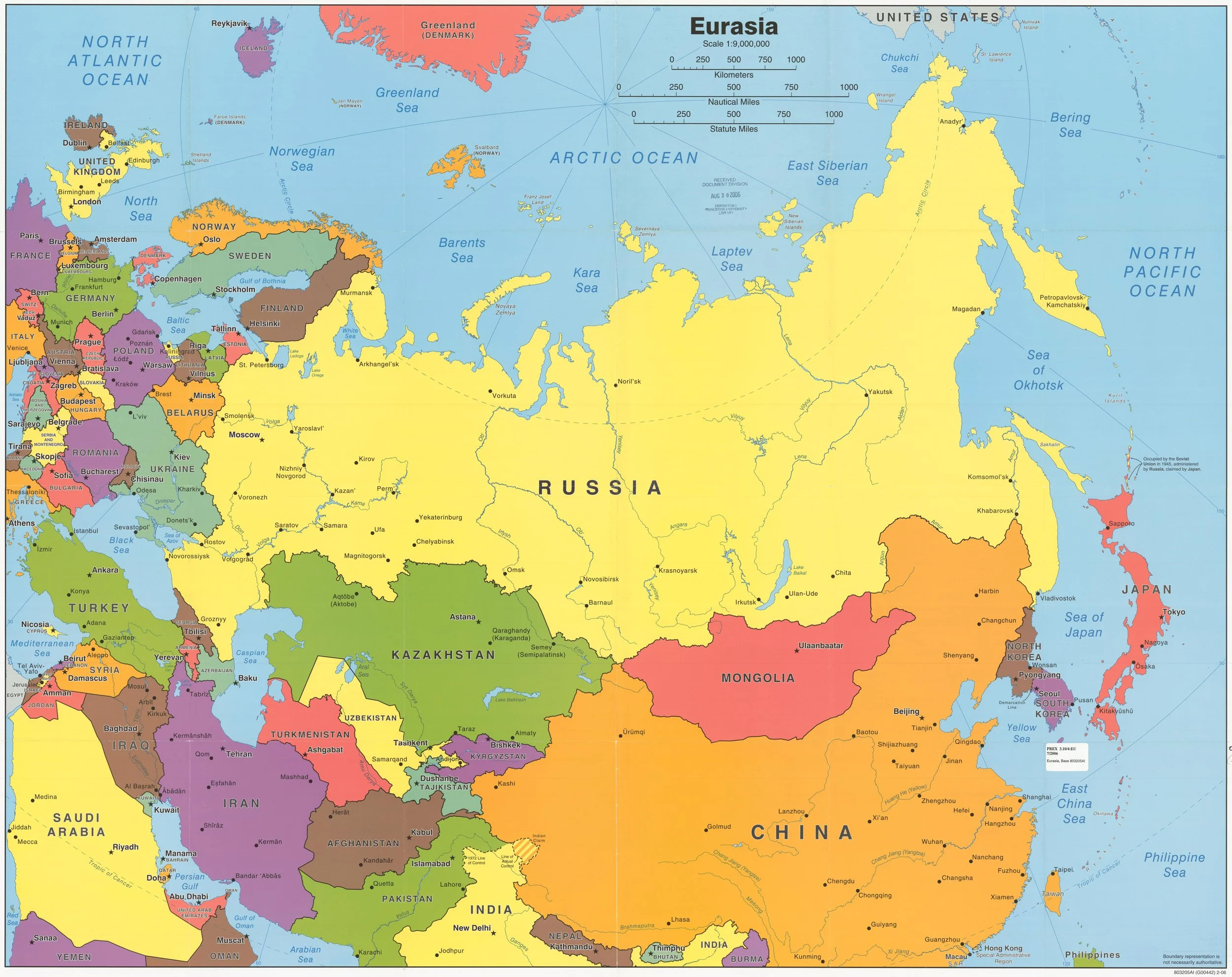
Credit: Central Intelligence Agency. (2006). Eurasia [Map; 803205AI (G00442) 2-06]. Retrieved from NYU/Princeton catalog
A New Kind of Cooperation
The most observable and blatant occupations in today's post-Soviet space – such as Russia’s ongoing war against Ukraine – are still undertaken using tanks, missiles, and troops. However, beyond military aggression, there is another, much quieter form of occupation emerging in contested regions like the South Caucasus and Central Asia. Authoritarian governments – Russia, China, Turkey, and Iran – are widely viewed as redrawing influence maps with soft power tools. In countries like Georgia, Armenia and Kazakhstan, digital media, humanitarian aid, religious outreach, and infrastructure development are delivered under the guise of cooperation but increasingly function as coercive tools. Over time, such influence is quietly altering the region’s civic space — reshaping loyalties, eroding norms, and displacing narratives.
This soft power expansion is driven in part by the growing assertiveness of authoritarian power systems but, more fundamentally, by the strategic and values-based disengagement of the West.
The Quiet Retreat of the West
Following the 2008 invasion of Georgia, the 2014 annexation of Crimea, and the full-scale invasion of Ukraine in 2022, the West’s response across the post-Soviet space has often appeared reactive and fragmented – reflecting a broader uncertainty about how to sustain democracy support in the face of renewed geopolitical confrontation. Although a limited form of cooperation through security frameworks has continued, long-term support for civil society, institutional reforms, and democratic leadership development has quietly diminished — a pattern reflected in declining global democracy assistance, as Western governments shift focus toward domestic and security priorities, and reduce development aid projects. The OECD projects up to a 17% drop in global Official Development Assistance (ODA) in 2025, a trend that will further constrain resources for governance and democracy programs across the post-Soviet states.
The European Union's vision – once brimming with hopeful acronyms and roadmaps for the Eastern Partnership Initiative (EaP) – has weakened. To some observers, the U.S. focus appears to have shifted to a more transactional foreign policy, viewing regions like the South Caucasus as logistical assets rather than democratic partners. This is further complicated by U.S. attempts at high-level diplomacy with Russia, Iran, and others.
This shift in strategy – as Western engagement pulls back from supporting core democratic institutions like independent courts, civil society, and free media – is weakening the region’s long-term resilience. In the resulting vacuum, authoritarian actors are using soft power tools such as targeted messaging, funding, and infrastructure development that expand their influence, shrink civic space, and stall democratic progress.
Coercive Cooperation: The Tools of Illiberal Influence
Russia’s geopolitical agenda in the regions of post-Soviet space goes beyond military engagement. It is a systemic and strategic approach and includes aid, identity, traditional values ideology, and information control. Russia's use of soft power and traditional values reflects a broader strategy aimed at reshaping neighboring societies from within – promoting a state-defined Russian identity and centralized power. The Russkiy Mir (Russian World) ideology positions Moscow as the protector of Russian-speaking communities beyond Russia’s borders and asserts a political duty to step in and support them.
In Georgia’s occupied territories of Abkhazia and South Ossetia, Russia regularly delivers humanitarian aid – including food, electricity, and medical supplies – while simultaneously erecting barbed-wire border fences along administrative boundary lines, granting Russian citizenship to local residents, and enforcing economic dependence. Installing loyal leadership in the so-called independent republics of Abkhazia and South Ossetia further demonstrates Russia’s firm control over any form of local autonomy in the occupied territories.
Alongside military presence and hardware, Russia employs narrative manipulation and disinformation to undermine pro-Western opinion. It disseminates traditionalist, anti-liberal ideologies across Georgia and the broader post-Soviet region through media networks that operate in the local language. Propaganda outlets like Sputnik and institutions such as the Russian Orthodox Church are central to this strategy. For example, Patriarch Kirill’s portrayal of the war in Ukraine as a “holy defense” reveals the ideological alignment between church and state.
Turkey sees a chance to step in as Western involvement has waned. Two of its main organizations – TİKA, which handles development and aid, and Diyanet, which promotes religious outreach – help spread Turkey’s political and cultural vision in neighboring countries. Its tools of influence include building schools, restoring cultural landmarks, and fostering religious and educational exchanges. In the South Caucasus, Ankara’s sway has grown significantly after helping Azerbaijan retake Nagorno-Karabakh, and Turkey aims to cement its role as a patron and protector in the area.
In recent years, Turkey’s foreign policy has become increasingly transactional. Despite being a member of NATO, Turkey favors the practical benefits of aligning with strong or loyal regimes over liberal democratic alliances. It trades in security, connectivity, and investment – not the reforms typically associated with Western involvement.
China's strategy relies less on cultural or religious tools and is more transactional and increasingly competitive with the West. Through Belt and Road investments, Confucius Institutes, and elite partnerships, China is exporting not just roads and railways but promoting development without democratization.
China’s offering is attractive to many governments in the region – billions in infrastructure investment, extensive transit corridors, and rapid modernization delivered faster and without requiring democratic reforms or human rights protections that usually follow Western aid. Beijing positions itself as a systemic alternative – a surveillance-enabled governance model where governments use technologies such as facial recognition, digital monitoring, and internet controls to maintain political control, monitor dissent, and shape public behavior.
Iran’s soft power in the South Caucasus and Central Asia is less pronounced but persistent, rooted in religious diplomacy and cultural outreach. It promotes religious soft power by building ties with Shi’a communities and sponsoring clerical education, religious education, and cultural centers – particularly in parts of Azerbaijan and eastern Georgia – framing itself as a spiritual counterweight to both Sunni influence and Western liberalism. It also promotes Persian culture through media, student exchanges, and charity groups. In addition, geography does the heavy lifting – with the exception of Georgia, all the states in the region are landlocked – and Iran offers a trade outlet and transit corridor. These efforts help Iran grow its presence without open confrontation, supporting political models that push back against democratic reforms.
Implications for Civil Society
The consequences of Western disengagement go beyond shifting borders or weakened alliances – they have deep negative social impacts. Illiberal regimes are unbound by democratic accountability, and their persistent and deliberate messaging and alternative models of governance steadily reshape public trust, civic norms, and institutional expectations.
As foreign-controlled narratives confuse and divide communities in the targeted states of the region, public trust in institutions declines. Civil society groups and non-profits, once supported by the West, are now labeled as “foreign agents” and pushed aside. The younger generation feels caught between conflicting worldviews. Women and minorities – who are often key to democratic progress – are excluded from national leadership roles and decision-making.
What the West Must Do: Integrating Infrastructure and Institutions
Recent U.S. efforts to re-engage in the South Caucasus – driven largely by logistical considerations – offer a faint hope for renewed Western involvement. The recent meeting between President Trump and Armenian and Azerbaijani leaders and signing of a preliminary peace agreement is a highly visible U.S. re-entry in Caucasus diplomacy, but the outcome will hinge on follow-through.
One initiative in this engagement is the U.S. proposal to broker the Zangezur Corridor through Armenia’s Syunik province, connecting Azerbaijan with Nakhchivan as a part of the broader Middle Corridor logistics network – a critical alternative route connecting Europe and Asia through South Caucasus. Coupled with revived interest in energy infrastructure projects such as the Baku-Tbilisi-Ceyhan and South Caucasus pipelines, the initiative presents a rare opportunity to realign geopolitical strategy with democratic goals.
The timing also seems right, as the broader U.S.-EU trade architecture has been reset. This shift aligns with renewed Western efforts to integrate infrastructure and governance goals. The recent U.S.-EU 15% tariff agreement explicitly connects economic cooperation with security alignment, signaling that trade and energy must come with democratic standards.
Yet, infrastructure alone is not enough to ensure the region’s stability.
The lessons of history reinforce a central truth: institutions matter most. Nowhere is this clearer than in the post-Soviet space itself – the world’s most cautionary experiment in rapid liberalization without institutional safeguards. As reforms were rushed through in the aftermath of the collapse of the Soviet Union in the 1990s, the absence of functioning courts, regulatory oversight, and civic protections allowed corruption and authoritarianism to take root. It took decades – and, in some cases, revolutions – to begin building functional state institutions, with progress varying significantly from one country to another. Today, the West should not discard these fragile institutions. Infrastructure, aid, and diplomacy must be deployed with intention – not as neutral tools, but as devices to strengthen transparency, accountability, and pluralism.
Without institutions, these connectivity corridors risk becoming instruments of soft coercion, unless the West is to be a credible counterweight. With them, it can become a path to resilience.
Deploy Infrastructure with Democratic Intent
Rather than allowing connectivity projects to become platforms for authoritarian influence, the West must ensure they serve as tools of democratic resilience. This requires embedding governance benchmarks into every new project – including transparent procurement rules, independent audits, financing disclosures, and public oversight mechanisms.
The emerging race for influence in the Caucasus and Central Asia will either entrench authoritarian networks or strengthen democratic institutions, depending on how intentionally Western actors tie economic access to democratic accountability. In practice, this means treating each infrastructure project not merely as a logistical asset but as a governance device – converting connectivity from geopolitical prize into a civic good.
Activate Existing Instruments: Turning Frameworks into Leverage
The United States and the West already possess an extensive portfolio of bilateral and multilateral agreements that could be transformed into vehicles of accountability. Strategic Partnership Charters, such as the U.S.-Georgia Strategic Partnership Charter (2009), the newly signed U.S.-Armenia Framework (2025), and trade and investment treaties with Azerbaijan – contain governance and transparency clauses that remain largely underutilized.
Similar leverage exists across the post-Soviet space. Moldova’s EU accession process and IMF support offers tools to reinforce democratic institutions – its recent election reaffirming pro-European trajectory and offering a renewed mandate for democratic conditionality. In Belarus, where direct engagement is currently suspended, Western actors can support exiled civil society and diaspora-led initiatives. A dormant legal framework under earlier Partnership and Cooperation Agreements could serve as a re-entry point once political conditions allow.
In Central Asia, agreements with Kazakhstan and Uzbekistan – including investment treaties and regional cooperation platforms under the C5+1 framework – offer opportunities to tie economic cooperation to governance reform and civic development.
USAID has long played a central role in advancing democratic development across the post-Soviet region. Where its presence has been terminated or constrained, as in Azerbaijan and Belarus, or is facing increasing restrictions, as in countries of Central Asia, other formats can fill the gap to preserve democratic momentum.
The European Union, despite internal fragmentation, retains powerful levers: the Eastern Partnership Initiative and Global Europe: Neighborhood, Development and International Cooperation Instrument (NDICI) already provide legal basis for conditioning aid with democratic performance. This can be strengthened through the EU’s rule-of-law conditionality mechanism, enshrined in the Association Agreements (AAs) (in the case of Georgia and Moldova), and Partnership and Cooperation Agreements, which link deeper political and economic integration to a country’s progress on democratic reforms.
Meanwhile, the EU’s Global Gateway and the G7’s Partnership for Global Infrastructure and Investment (PGII) provide a powerful economic counterpart to this political leverage, offering financing that is tied to transparent, environmentally conscious, and publicly beneficial standards – an alternative to the illiberal influence models such as China’s Belt and Road initiative.
International financial institutions can add another tier of conditionality. The European Investment Bank and the European Bank for Reconstruction and Development (EBRD) already require accountability benchmarks in their partnership portfolios, while the World Bank and IMF have embedded rule-of-law and anti-corruption measures in their sovereign loan agreements.
These bilateral, regional, and global financial frameworks form the effective architecture of conditionality. Activating them would not require new treaties or vast resources – only political will and institutional coordination. When applied deliberately and with conditionality, these instruments can ensure that connectivity projects and financial flows strengthen judiciary, the rule of law, and civil societies, transforming the infrastructure race from a geopolitical competition into a democratic one.
Make Education and Media a Strategic Priority
Authoritarian influence does not advance only through corridors and pipelines – it exploits information and educational vacuums. To counter this, Western engagement must treat education and media as core pillars of strategic influence. This means supporting media literacy, civic education, and independent journalism with the same intent and urgency that guide infrastructure and security assistance.
In Moldova, EU-supported media hubs have helped local outlets expose corruption. In Kazakhstan, regional journalism networks offer fact-based reporting that challenges disinformation. In Georgia, civic education programs are introducing media literacy into school curricula. EU-funded initiatives like EU4 Independent Media bolster the region’s democratic information ecosystem by supporting cross-border investigative journalism across Armenia, Azerbaijan, Belarus, Georgia, Moldova, and Ukraine.
These efforts offer scalable models of resilience – demonstrating how the West can help societies build democratic defense mechanisms from the ground up, with access to information and pluralistic media forming the deterrence against authoritarian soft power.
Conclusion: From Retrenchment to Renewal
The contest unfolding in the post-Soviet space is not just about access – it is about alignment. Competing infrastructure projects and trade routes will shape the region’s future, but the West must decide whether its presence is transactional or transformational. It still holds powerful assets – alliances, institutions, and credibility – but to counter the assertiveness of authoritarian power-systems, these instruments must be deployed with purpose: embedding governance into connectivity, applying conditionality to aid, and investing in education and media that empower citizens and protect civic space.
When Western democratic soft power meets the hard borders – geopolitical and ideological – erected by authoritarian regimes, its strength will be tested not by scale but by resolve. What is ultimately at stake is not only strategic influence but whether societies can remain open, informed, and free to determine their own course. If the West fails to translate its values into strategy, it risks ceding not just influence but the social foundations of democratic resilience in the region itself. That test is already underway.
About the Author:
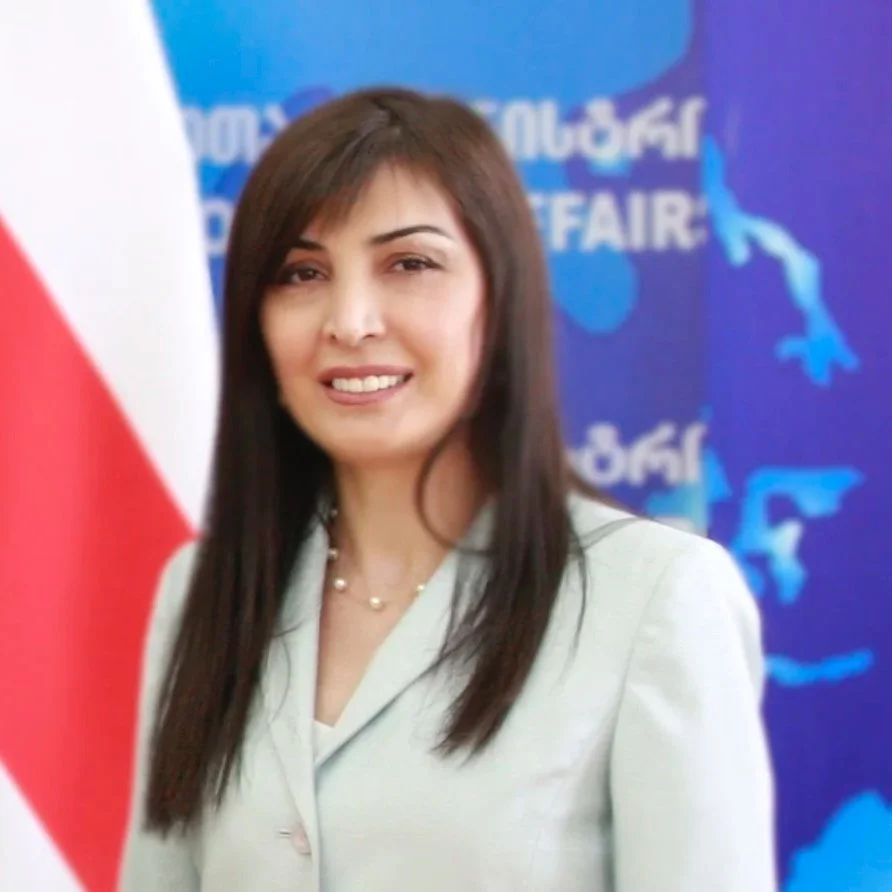
Ambassador Khatuna Salukvadze is a diplomat, scholar, and international security expert whose work focuses on international security, democratic resilience, and transatlantic policy. A 2021/2023 Fellow and 2024 Senior Fellow at Harvard’s Advanced Leadership Initiative, she is currently a Fellow at Harvard University’s Davis Center for Russian and Eurasian Studies. Khatuna served as Georgia’s Ambassador to Lithuania and held senior diplomatic and advisory roles shaping the country’s Euro-Atlantic integration and reform agenda. Her work bridges diplomacy, policy, and civic development to strengthen democratic institutions and transatlantic cooperation.