
Credit: AI-generated editorial illustration, AI, Governance and Morals
Somewhere today, an algorithm will decide that a 64-year-old widow does not qualify for a car loan. No one will review the file, and the explanation she receives — a reason code on a form letter — will tell her almost nothing about why. Multiply that experience across every consequential decision an institution now routes through a machine, and the problem becomes clear: Artificial Intelligence (AI) is governing us, instead of the other way around.
AI systems are making consequential decisions about people’s lives at an unprecedented scale — who gets a loan, who gets hired, who receives healthcare. The opacity of AI models means that these decisions happen in a black box. Often, neither the person relaying the decision nor the person receiving it will understand the rationale. Many organizations have adopted AI usage policies or created review committees, but a late-2025 survey of senior executives across a range of sectors published by Kyocera and Economist Impact found that only 8% of organizations had implemented a comprehensive AI governance framework. The result is fragmented AI governance that creates institutional risk and compounds harm to those the institution serves.
For example, one AI tool used widely in the U.S. healthcare system was found to wrongly prioritize white patients for treatment over Black patients who were just as sick. In another example, SafeRent Solutions settled a case for more than $2 million after its tenant-screening algorithmic tool was alleged to disproportionately deny Black and Hispanic applicants. In financial services, a 2025 U.S. Government Accountability Office report warned that AI models trained on data rife with existing biases about who is creditworthy can perpetuate those very same inequities.
To mitigate these harms, leaders across sectors need a “moral architecture” for AI — not a set of aspirational guidelines, but a structural framework that governs how AI systems are designed, deployed, monitored, and retired in line with an organization’s values. This article outlines the case for the moral architecture, what we’ve learned from testing and refining it with 15 values-based financial institutions across six continents, and how leaders in any sector can implement their own framework. Although this article focuses on institutional action rather than individual case studies, the framework is intended to be accountable to the borrowers, workers, patients, tenants, and communities most affected by automated decisions.
A Moral Architecture for AI
The appropriate response to AI is grounded in morals because AI can make or materially shape judgments at unprecedented scale and complexity. It makes decisions, and the person affected cannot see its reasoning. But even when a system produces a judgment, the institution deploying that system is the one responsible for its moral and ethical implications.
The moral architecture we propose includes three distinct components: First, ten moral principles or values that should guide AI governance. Second, the opportunity to deepen and scale mission impact, together with eight risks or harms the governance framework should address. Third, nine pillars that turn those moral principles into operational governance practices. The framework was developed with affected communities in mind and refined through conversations with mission-driven leaders, as well as employees responsible for implementing these systems.
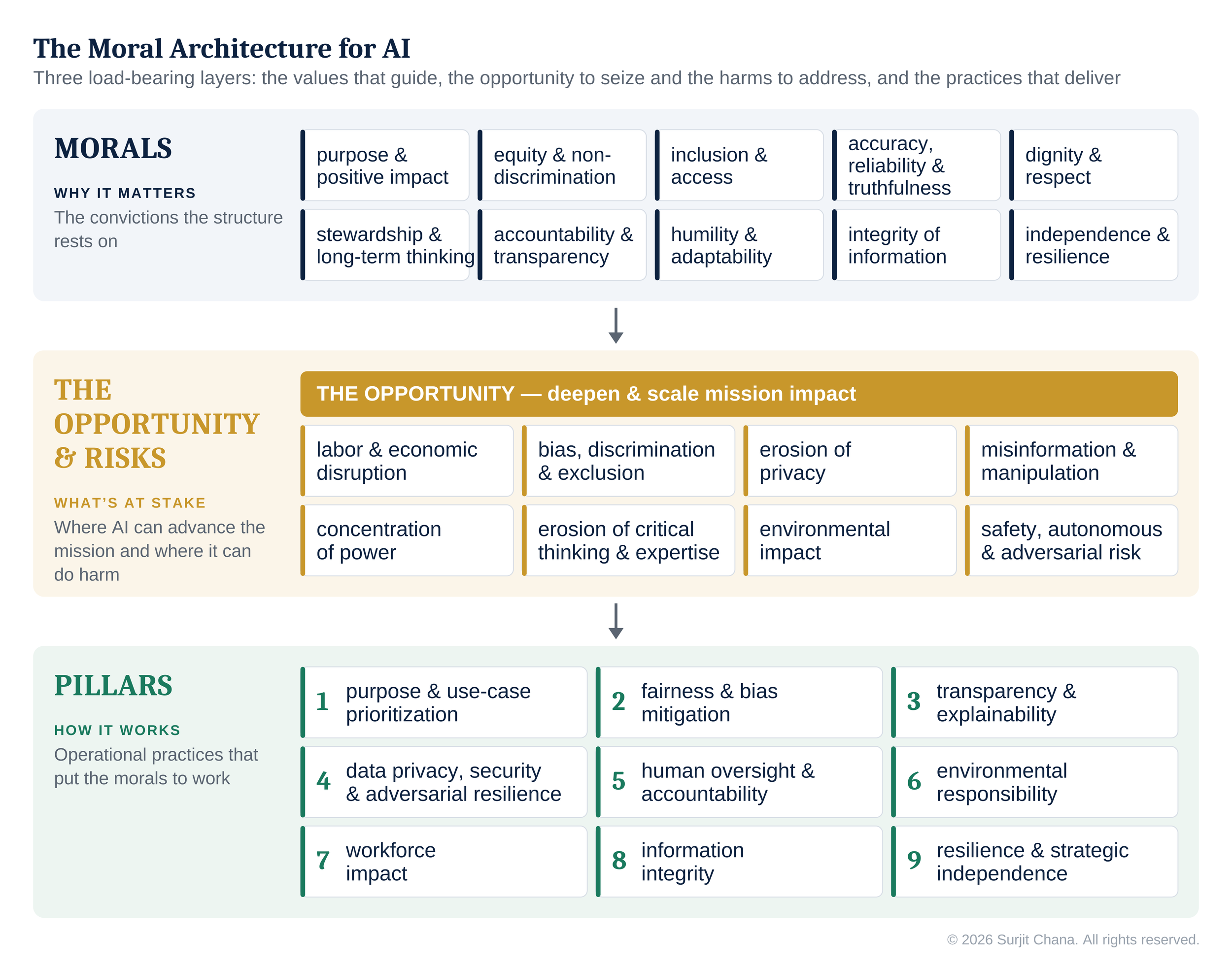
The word “architecture” is used in its technical sense of load-bearing elements, defined relationships, and principles of evolution. The moral architecture starts with ten distinct moral principles that should guide leaders’ governance of AI:
purpose and positive impact;
equity and non-discrimination;
inclusion and access;
accuracy, reliability, and truthfulness;
dignity and respect;
stewardship and long-term thinking;
accountability and transparency;
humility and adaptability;
integrity of information; and
independence and resilience.
The moral architecture also recognizes the significant opportunity inherent in AI, particularly its potential to deepen and scale mission impact. Informed by the MIT AI Risk Repository, a peer-reviewed synthesis of 74 existing frameworks, we identified eight key risks that AI governance should address:
labor and economic disruption;
bias, discrimination, and exclusion;
erosion of privacy;
misinformation and manipulation;
concentration of power;
erosion of critical thinking and expertise;
environmental impact; and
safety, autonomous, and adversarial risk.
These eight risks were distilled from the MIT AI Risk Repository’s broader taxonomy by asking which risks matter most where AI makes or materially shapes decisions about people’s access to essential services. The selection was then further tested through the validation workshops described below, which — among other refinements — pressed for fuller treatment of risks specific to institutions serving the Global South.
Finally, nine operational pillars translate these principles and risks into practice:
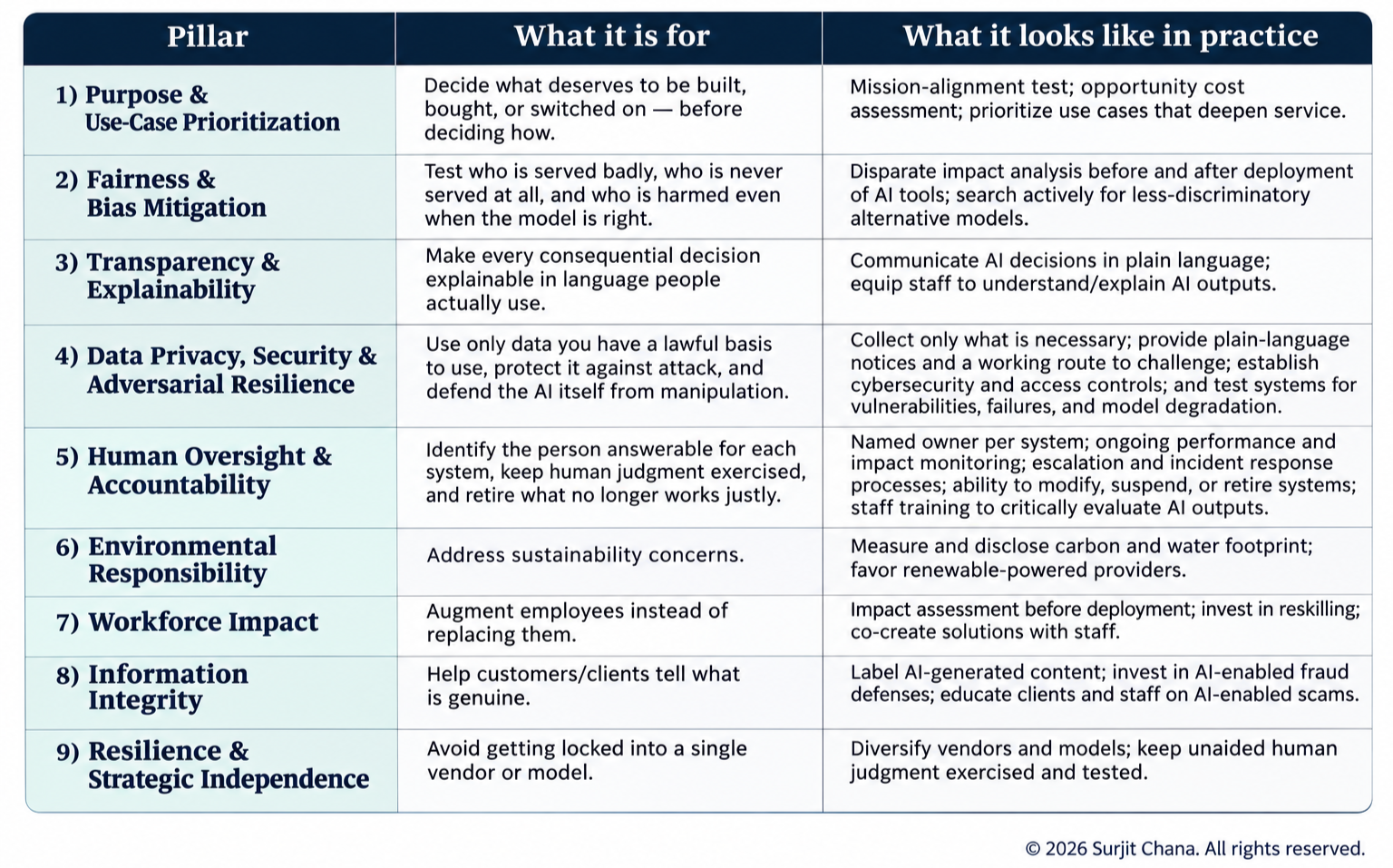
The following example illustrates how the nine operational pillars can be applied in practice:
Imagine you are a leader at a community development financial institution that is considering using AI to expand credit access. You would start by asking whether an AI tool should be used for this application at all (Pillar 1), especially given its impact on the ability of borrowers to purchase their first home or finance small business growth. Will it help or hurt? If you decide to move forward, other pillars might guide the selection of the right AI vendor and model — for example, whether you can find one that is verifiably less discriminatory (Pillar 2) or one that runs on renewable energy (Pillar 6). Next, you’ll want to establish clear ownership and responsibility for this use case (Pillar 5) and to work with employees to design and implement the rollout (Pillar 7). Through the right documentation and training, your staff are then able to communicate to customers in plain language about what data is being collected, how AI contributes to decision-making, what recourse they have to challenge loan denials, and how to avoid AI-enabled scams (Pillars 3, 4, and 8). Longer term, you build a process to consistently reassess your AI tool/vendor and pivot if this infrastructure no longer serves its purpose (Pillar 9).
These are not sequential steps, but mutually reinforcing commitments. Transparency without accountability is just a toothless disclosure. Bias mitigation without explainability leaves people confused and unable to challenge decisions. Strategic independence without workforce investment hollows out the very human judgment the whole structure depends on. Skip any one pillar, and the others start to wobble. While each organization will deploy an architecture that fits its operational structure, mission, and capacities, all nine pillars should be considered.
Every use-case review should consider the perspectives of affected customers, employees, and community representatives, not only the institution’s legal, compliance, and technology teams.
What Early Adoption Looks Like
Deploying a moral architecture for AI doesn’t require a large technology budget or a team of data scientists. It can be done by building a scaffolding on existing governance structures that asks the right questions before, during, and after any AI deployment.
Beneficial State Bank, a B Corp-certified community bank with roughly $2 billion in assets, provides an early-stage example. The bank’s unique ownership structure — where the nonprofit Beneficial State Foundation acts as the majority equity holder — permanently aligns its economic interests with the public good. In January 2026, the board (on which I sit) approved a comprehensive AI strategy for 2026-2029, grounded in the moral architecture concept. The bank’s approach is deliberately positioned as a prudent fast follower, not a bleeding-edge experimenter. Like most organizations, Beneficial State Bank is building on vendor tools rather than developing its own AI models. That makes vendor governance central to its strategy; for example, AI vendor roadmaps are now reviewed as part of the bank’s annual IT planning cycle, not just at the point of purchase.
In practice, everything runs through a two-step oversight process. The bank’s IT committee handles operational intake and prioritization, while a separate risk committee approves each use case before it goes live. Staff maintain a living inventory of every AI tool in use, and each tool has a designated business owner attached to it. The board receives regular reporting on AI progress, risk posture, and vendor performance.
The architecture has also been reviewed and refined through validation workshops with 14 other financial institutions on six continents, all members of the Global Alliance for Banking on Values. They range from European sustainable-banking pioneers to microfinance leaders in Latin America and Africa, cooperative lenders in North America, and a customer-owned bank in Australia. Collectively, these institutions serve millions of people with limited access to conventional finance, which made them demanding validators: for them, inclusion is not aspirational language but part of the business model.
Participants were asked to evaluate the framework against their own regulatory context, vendor landscape, and client base, using a structured feedback template. Their reviews led to substantive changes in the framework. For example, vendor governance moved to the center of the framework, reflecting the fact that most institutions deploy models built by others rather than developing their own. Guidance was made proportional to institution size and to the consequences of each use case. The risk framework was also expanded to address concerns raised by institutions serving the Global South. Most striking, however, was what did not vary: participants operating under profoundly different regulatory regimes converged on the same core moral commitments.
Success, in this framework, is defined by measurably better outcomes — not the existence of process. Each pillar is paired with the evidence that would show whether it is working: approval or service rates by customer segment, disparate-impact results before and after deployment, override and complaint patterns, vendor audit findings, measured environmental footprint, and the reach of reskilling. The precise metrics will differ by institution, but the requirement does not: every pillar must identify its observable evidence and the point at which review can force change, so that governance is judged by outcomes rather than intentions.
Beneficial State Bank’s AI governance execution and the global review and refinement of the framework are both in the early stages. But together they show what it can look like to start deliberately and ask the right questions. If early adopters, many of them with limited technological resources, can build this foundation, so can any organization.
Where to Start
For organizational leaders who want to implement their own moral architecture for AI, here are six initial steps that can generally be built on top of existing processes:
Know what you’re deploying. Build a living inventory of every AI system your organization uses, including tools your vendors run on your behalf. For each one, ask: What decision is this making and who is affected if it’s wrong?
Name who’s accountable. Establish a basic set of controls by naming one person who’s accountable for AI overall and one for each consequential system in your inventory. They should also be empowered to shut down an AI tool if it’s causing harm or not serving the organization’s needs.
Test for mission alignment. Before approving any AI use case, ask what mission or stakeholder value it would create beyond cost reduction. A useful thought experiment: would you still build it if it saved the organization nothing? No new committee required; just a new question to kick off an existing review process to ensure mission alignment is the primary consideration, rather than efficiency alone.
Decide one thing you will not build. Any good governance framework should sometimes result in a “no.” If every AI use case is approved, the process risks becoming little more than a rubber stamp. It’s important to get in the habit of treating a declined AI use case as a legitimate outcome that helps build discipline and offers its own lessons.
Use your vendor contracts as a governance lever. Most institutions aren’t building AI, just deploying models built by others. Therefore, fairness, transparency, and accountability must be built into the contracts you sign and renew with vendors. This can include clauses related to audit rights, fairness testing requirements, and data-sharing limits.
Make AI oversight an ongoing leadership responsibility. It should not be a one-time approval or a compliance checkbox. The same discipline applied to financial audits and legal compliance should apply to systems making consequential decisions about people’s lives. That means regular reporting to leadership and the board on AI performance, impacts, and harms.
In a world where AI technology is moving fast, and regulators are lagging behind, these six steps can put organizational leaders on a path to regain control.
Chosen, Not Inherited
Every AI deployment already encodes values. The only question is whether those values were chosen deliberately or inherited silently from legacy incentives. An institution that declines to choose has still chosen.
As AI use becomes more widespread, governance approaches will shape who gets credit, care, housing, and work, and whether we entrench inequality or advance inclusion. For social impact leaders, deciding which values are embedded in these systems is among the most important design decisions they will make. The architecture is beginning to be put into practice and refined by institutions with much at stake. What remains is the choice in front of every board and leadership team: whether the values inside their AI deployments will be selected for them or by them.
About the Author:

Surjit Chana is a senior technology, digital transformation, and marketing executive with deep general management and governance experience. He currently serves as a board director of Beneficial State Bank and Bancorp, and as a member of the Technology Steering Committee of the Global Alliance for Banking on Values. A former member of IBM’s Global Senior Leadership Team, he held senior leadership roles spanning technology, digital transformation, strategy, operations, and marketing, including Chief Operating and Strategy Officer of IBM Digital. An innovative technology developer and patent holder, he developed and implemented global growth and transformation strategies across IBM’s software, hardware, and services businesses. He was a 2017 Harvard Advanced Leadership Initiative Fellow and continues to work on his two fellowship projects focused on using technology for social good and solutions for homelessness.